Pages

Showing posts with label historical fiction. Show all posts

Tuesday, December 8, 2015

Danger, Dancing, & Daring -- THE NOTORIOUS PAGAN JONES by Nina Berry


The Notorious Pagan Jones
by Nina Berry

Intertwined with historical events surrounding the formation of the Berlin Wall in 1961, The Notorious Pagan Jones traces the rise, fall, and recovery of former film sweetheart Pagan Jones. After Pagan kills her family in an accident, she is sentenced to juvenile detention—a rather light sentence compared to the tortuous guilt weighing on her. When the opportunity to star in a Berlin-based film presents itself, Pagan takes the chance, borne on the arm of her now “legal guardian,” Devin Black.

What Pagan slowly realizes is that her role in this film is merely superficial; her real objective is to assist Devin infiltrate the East German government, the role of a lifetime. Danger, dancing, and daring capers fill the pages of Pagan’s adventure and her climb back to stardom.

VERDICT: Fast-paced, fun, and furious, The Notorious Pagan Jones is a certain hit with those who love historical fiction, Hollywood, and redemption. Fans of Code Name Verity (Elizabeth Wein) and Between Shades of Grey (Ruta Sepetys) will not be disappointed with Nina Berry’s latest.

Note: I reviewed this book for School Library Journal.

Wednesday, December 2, 2015

The Self-Absorbed Artist: THE DREAM LOVER by Elizabeth Berg


The Dream Lover
by Elizabeth Berg


Boy, where do I begin with this one? I love a good historical fiction, especially if the historical fiction in question is focused on a famous literary figure. For instance, I recently read Mr. Emerson’s Wife, and was pleasantly surprised at the supposed nuances of Mrs. Emerson and Mr. Emerson himself. Even though they were not perfect characters, I rooted for them to each find their own version of happiness.

But Aurore Dupin, as known as George Sand, is a severely unlikeable character. The novel bounces around from her childhood to her rise to literary prominence. I imagine the childhood scenes are to paint a picture of a complex girl, but all it does is cause me to wonder what made George so unlikeable.

George marries a man she does not love, and regularly abandons her children to go write and hussy around in Paris. Even during her “scheduled times” with her children, she often left them with the servants and went away on love trips. Someone so self-absorbed and selfish is not a heroine in any sense of the word.

Everything must revolve around George and her happiness with her love life; she takes on many different lovers, which in itself is not a big deal, but she is still married for the majority of them. Also, she becomes so wrapped up in her love affairs that she neglects her children and her home.


While I realize that many “great artists” of that time were definitely outside of the societal box, there is not much to redeem the character, and/or the person, of George Sand. If Berg’s goal is to create a thoroughly reprehensible character, then she succeeded. The mere fact that this novel's protagonist enrages me so much is testament to the excellent character building by Berg. Recommended with the caveat that you will be annoyed with George!

Saturday, November 28, 2015

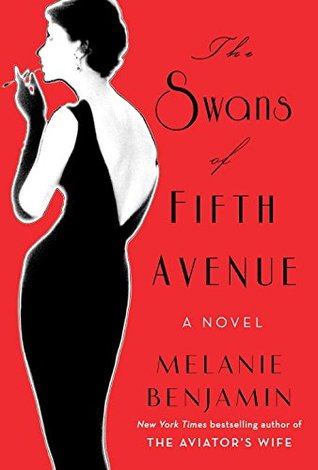
"The swan, like the soul of the poet, By the dull world is ill understood": Review of SWANS OF FIFTH AVENUE by Melanie Benjamin

(Title quote by Heinrich Heine)

The Swans of Fifth Avenue
by Melanie Benjamin

Drenched in whiskey and jewel-toned silks, the famous socialites of 1960s New York come alive in Melanie Benjamin’s latest tour de force. If you’re like me, nothing is as delicious as reading about the sumptuous lives and dramas of the “rich and famous”—and Benjamin certainly delivers on this front.

Truman Capote is launched into the social scene thanks to his indelible and incisive works, including In Cold Blood and Breakfast at Tiffany’s. Babe Paley, Slim Keith, C.Z. Guest, Gloria Guinness, and Pamela Churchill all are Capote’s “swans,” or beautiful circle of friends—but Capote’s true love is Babe. Married to a cheating and demanding husband, Babe Paley, instead of getting angry, turns her own body into a work of art, becoming one of the most famous socialites of the era. Babe and Truman share a special bond; he is her “True Heart,” and she is his “Bobolink.” That is, until Truman attempts to fictionalize Babe’s secret shames in a short story La Cote Basque 1965. Truman’s swans turn their backs to him and he begins a downward spiral into alcoholism.

A fascinating book is one that completely immerses me within the scene, one that propels me to research different people and artifacts mentioned with the book. Swans of Fifth Avenue is such a book; highly recommended!

One of my favorite parts:

            “…and all she could look forward to was losing her teeth, more face-lifts, orthopedic shoes instead of Ferragamos, the constant battle of the dye bottle…and all the money in the world couldn’t stop any of that, couldn’t stop the ravage of time and great.
            And that was the secret, the wonder of Truman, she realized suddenly. Truman made them forget all that. He had amused them. Their husbands didn’t want to talk to them. They grew bored talking to one another, these glorious creatures, for they were all the same. Blond, brunette, tall, short, European or Californian, they were still the same; only the exteriors were different. And they devoted their lives to maintaining this difference, striving to shine, be the one jewel who stood out. Yet at night, they took off the diamonds and gowns and went to empty beds resigned to the fact that they were just women, after all. Women with a shelf life.
            And then Truman leapt into their midst, and suddenly the gossip was more delicious, the amusements more diverse” (Benjamin 244).

Wednesday, July 22, 2015

On a Scale of One to Pomegranate....BEASTLY BONES by William Ritter


Beastly Bones: A Jackaby Novel
by William Ritter


R.F. Jackaby and his trusty assistant, Abigail Rook, investigate fascinating and mysterious forms of paranormal phenomena in the latest series offering.these and more paranormal phenomenon in the latest series offering. In this sequel to Jackaby (Algonquin, 2014), Ritter seamlessly presents enough backstory for newcomers to thoroughly enjoy this hybrid of historical fiction and fantasy. Jackaby and Rook are called to probe into a series of strange murders—could it be vampires or jiangshi (zombies in Chinese folklore)? After following a lead to the picturesque Gad’s Valley, they literally unearth one of the most exciting and dangerous animals of all time. The protagonist’s flighty perspicacity pairs well with Rook’s down-to-earth demeanor, and together the pair work to overcome a threat to the entire world.

On a scale of “one to pomegranate,” this volume is undoubtedly a pomegranate; it offers humor, adventure, mystery, gore, and romance all rolled into one well-written package. The best news? There is more to come, as Ritter sets up Jackaby and Rook’s next case regarding the ephemeral Jenny, murdered many years ago.

VERDICT: Recommended for fans of Jonathan Stroud’s “Lockwood & Company” series (Disney-Hyperion).

This review was published in School Library Journal‘s July 2015 issue and can also be viewed online.

Tuesday, February 17, 2015

Somehow Marigolds Come Into Play -- A Fall of Marigolds


A Fall of Marigolds
by Susan Meissner

I wanted to like this book; Meissner attempted to deftly weave similarities between a woman living and working in 1911's NYC and a woman living/working in present-day NYC (having suffered a tragedy in the 9/11 terrorist attacks).

I felt the parts dealing with the present-day (and the near-past flashbacks to 9/11) were handled fairly well; they felt raw, real, and organic.  My issue with the novel stemmed from the 1911 flashbacks, which focused on a woman who lost a potential love in the Triangle Shirtwaist factory fire.

Clara met and fell in love with Edward in the elevator to the building; they had not even gone on a date when the fire broke out and Edward tragically died.  Trying to escape the painful memories, Clara volunteered for a stint on Ellis Island as a nurse.  A brief stint turned into months of near-isolation as Clara attempted to move past the tragedy that has now overtaken her life.

Clara, to me, is a weak and unrealistic character.  Every person around her handles her with kid gloves.  She is repetitive and quite honestly too overwrought; it is obvious she has some severe mental issues going on, but instead of forcing her to confront them and get treatment, her friends and family pander to them.  It's infuriating.  Somehow she gets two men to fall in love with her, too.  Whatever!

Wednesday, February 11, 2015

"Well, if Fortune Be a Woman, She's a Good Wench..."


Wench
by Dolen Perkins-Valdez

After weeks of reading mediocre literature, I was about to give up and forego my nightly ritual that I've had since childhood of reading until I go to sleep.  Luckily, I came across Perkins-Valdez's novel, Wench, which had me riveted.

The story involves a group of four female friends, who are slaves, and their vacations to the "free country" up North.  All of the women are involved sexually with their Masters, and the protagonist, Lizzie, is in love with her Master, Drayle.  The women are constantly tempted to run for freedom, especially when they discover free blacks in Dayton, and are befriended by a white Quaker woman.  They experience an extreme of unpleasant situations and adversity; I began to really ache for their heartaches, but the characters seemed to accept most of the situations as normal--which in itself is heartbreaking.

The only thing that I did not understand was the love Lizzie had for Drayle--I really didn't see a love story there, and I assume I am not supposed to.  However, Lizzie seemed more intent on manipulating Drayle for special favors than being in love with him.

Perkins-Valdez uses realistic dialogue and smooth, cadenced narration to create an unforgettable historical fiction novel.

Wednesday, February 4, 2015

A Mystery Wrapped in an Enigma Wrapped in a Riddle -- "The Shogun's Daughter"


The Shogun's Daughter
by Laura Joh Rowland

Listen, I appreciate an ARC as much as any person; a beautifully-appointed hardcover ARC is relatively unseen, so I eagerly cracked open Rowland’s The Shogun’s Daughter.  Some background: I have a B.A. in English literature and I also began my Masters in English Literature with an emphasis on the Japanese short story; I was and still am fascinated with the mystic realism inherent in Japanese literature.

Rowland writes well, in the sense that her syntax flows naturally, her imagery is rich, and she wraps up all of her plots points.  However, this novel of feudal Japan left much to be desired.  It is, essentially, a murder mystery, but given Japan’s loose definition of the word “justice,” many will be frustrated by the so-called “plot twists.”  Also, there really is no “mystery”—it’s quite easy to discover who is responsible for what in this story.

Probably the most frustrating plot line is that of Hirata; everything about the mystic warrior is just so ridiculous and contrived, I found myself eventually skipping over anything having to do with him and his “ghost.”

Pass on this unless you feel like getting yourself frustrated.

Sunday, February 1, 2015

I'm Dead, But Will You Marry Me?


The Ghost Bride
by Yangsze Choo

Yangsze Choo’s The Ghost Bride deeply delves into the underbelly of Malayan afterlife; after the son of a rich household dies without a wife, Li Lan’s family is approached with an offer for her to become a “ghost bride” to the deceased.  Naturally, Li Lan balks, but not before forming what can only be described as a crush on the nephew of the household, Tian Bai.

When a medicinal treatment goes awry, Li Lan learns firsthand what the spirits in the Malayan afterlife experience; she is not yet a ghost but she is not fully in the land of the living.  A rich mythology of beliefs combine to form a fascinating portrayal of the afterlife: will Li Lan be able to find her mother, long since deceased, in the Plains of the Dead? Can the mysterious Er Lang assist her in breaking the bonds with her near-ghost-husband?

I found this to be a very dream-like novel, one in which Malayan notions of the afterlife were so contrary to my own that it was difficult for me to relate.  However, it is truly fascinating, and Choo does a commendable job in melding together multiple religious viewpoints (as is the case with such territories as Malaya).  Perhaps the ending tied up too neatly and quickly, yes.  And perhaps I finished the book and found the notes, and thought, “How handy this would have been beforehand!”  So, if you haven’t read this yet, definitely be aware there are nifty notes in the back that explain quite a bit.

I Don't SEE the Point: China Dolls


China Dolls
by Lisa See

This novel was definitely a miss for me--I guess nothing will live up to Snow Flower and the Secret Fan.  The premise of the novel was promising (hence why I requested it for LibraryThing's Early Reviewers) and I love the historical time period...BUT...these girls seem to despise each other.

The early chapters are filled with rude remarks to each other (and snarky thoughts about each other); and then, to help the plot-line along, since they have to be friends, the girls just think/say, "Well, we have to stick together anyway, so it is what it is" <--paraphrase, obviously.  Because these girls are so derogatory about each other, it made me unsympathetic to their plights and I did not care what happened to them.

Saturday, January 31, 2015

What is The Cure For Dreaming?


The Cure For Dreaming
by Cat Winters


Consider this: what if you could tell a person’s true nature just by his appearance?  Emotional vampires would present with fangs and a ghastly pallor; feeble, miserable individuals flicker in and out of existence.  Cat Winters’s The Cure For Dreaming explores this question and more in her latest historical fiction novel set in Portland, Oregon, in the year 1900.  The daughter of a cruel dentist, Olivia Mead is called onto stage at a show to be hypnotized by the young, yet famous, Henri Reverie.   Her furious father enlists Reverie’s help to browbeat Olivia into her proper role as a woman, forcing her to “see the world the way it truly is.”  When Olivia realizes she cannot voice her dissent, and that she can truly see peoples’ natures, she must take her future into her own hands with the help of Reverie – all set within the backdrop of a dynamic suffragist movement.


Winters combines the history of women’s rights in the early twentieth century with a spell-binding story of a young woman caught at a crossroads between family and self.  A strong female protagonist, realistic dialogue, and well-written prose allow the reader to become immersed in Olivia’s rather unique (and sometimes frightening) world.  Aesthetically, bibliophiles and novices alike will love the old-fashioned introductory chapter photographs with leading quotes.   A timeline of “When and Where U.S. Women Gained Full Suffrage” and Recommended Reading are included.

Monday, September 23, 2013

"[T]his grim, ungainly, ghastly, gaunt, and ominous bird of yore..." - Bellman & Black


Bellman & Black
by Diane Setterfield

Bellman & Black explores “The Butterfly Effect” on a gothic, morbid scale; Will Bellman’s seemingly unintentional act of animal cruelty as a young boy has lasting and spreading effects as he continues to age.  Throughout the novel, the “rook” (a crow, essentially) is cast as the harbinger of death, interspersed by factual tidbits about the rook’s eating habits, scientific names, and so on.  The juxtaposition of the rook as a death symbol with these reminders of the unavoidability and impersonality of nature serve to remind us that death does become us all.  So why was Will Bellman targeted?

Will takes over a family business and his life becomes consumed with entrepreneurship; the book does become immersed in the details of his businesses, which I personally found engrossing.  However, for each bit of happiness Will experiences, the rook flits through the pages, bringing another round of death and sadness for Will.  Instead of properly dealing with his losses, they propel Will to work harder, shunning any kind of pleasure for the sole purpose of work.  At each funeral Will attends, he meets a man simply named Black.  They go into business together; the terms are vague.  The business consumes Will and he becomes determined to “pay back” Black his portion of the profits.  The ending, while not necessarily a surprise, is still a bit of a letdown—while Will is not a warm and fuzzy character, he is not a moral reprobate.

Which brings us to the crux of the problem with Bellman & Black – why did the simple act at the beginning of the novel, something that, truly, was not fully intended in a malicious manner on Will’s part, bring about such devastation in the end?  Will killed a rook—so everyone he loves dies.  I feel that Setterfield wants us to dig deeper into the allegory of the novel; one small act can wreak larger havoc, yes, but if a person does not boldly face a problem or an issue, Setterfield seems to say, it all becomes exacerbated.  If only Will had taken small moments to enjoy his pleasures more (as evidenced at the very, very end of the novel, when he went through just the very few happy memories he had).  If only Will had been, yes, a bit more selfish and lived his life more for himself instead of being regulated by the external world.

All in all, this novel is more profound than what it seems. I also found the minutiae of running a mill and starting a goods business quite fascinating; it fed into the larger theme of small gears making everything else tick (or break, as it were).